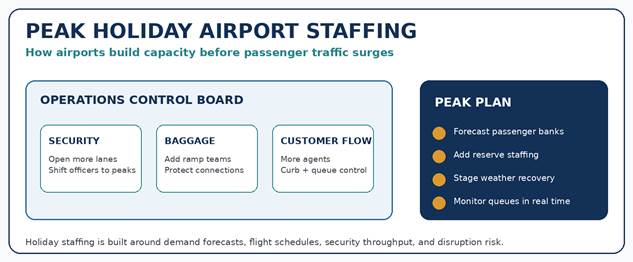
Holiday Staffing Starts Months Before the Travel Rush
Airports do not wait for Thanksgiving or Christmas week to add people. Staffing plans begin with airline schedules, passenger forecasts, expected checkpoint volume, connecting-flight banks, parking demand, weather risk, and historical queue data. Operations teams then identify the hours and locations most likely to need extra coverage.
The process is dynamic. Large hubs adjust staffing as flight schedules change, while smaller airports may focus on a few intense departure waves each day. A single delayed bank of flights can shift security lines, gate activity, baggage workload, curb traffic, and customer-service demand at the same time.
1. Security Staffing Is Matched to Passenger Peaks
Airport security planning starts with projected checkpoint throughput. Managers review expected passenger counts by hour, the number of open lanes, TSA PreCheck demand, equipment availability, and historical wait times. Officers may be reassigned among checkpoints or scheduled on reserve coverage when early-morning, afternoon, or evening banks are expected to surge.
Current 2026 airport planning shows how closely staffing follows forecast demand. Denver International Airport expected more than 368,000 passengers through security during the 2026 Labor Day period and identified specific peak windows when lines were likely to be longer. DFW projected about 1.4 million customers over its Labor Day travel period, with its busiest day exceeding 256,000 travelers.
Job seekers interested in the federal screening side of airport operations can browse TSA Jobs and compare security roles with airline, airport-authority, contractor, and customer-service positions.
2. Airlines Add Reserve Employees and Rebuild Schedules
Airlines prepare for holiday peaks by increasing reserve coverage for flight attendants, pilots, gate agents, ramp workers, baggage teams, and operations staff. Reserve employees give the operation extra capacity when a flight is delayed, a crew misconnects, weather forces a schedule change, or an employee calls out.
In 2026, airline staffing plans have continued to track seasonal flying closely. At large hubs, reserve staffing rises during summer and holiday peaks, then drops during slower fall periods before ramping back up for November and December. This approach gives airlines flexibility without staffing every day at the highest possible level.
3. Baggage and Ramp Teams Are Positioned Around Flight Banks
Holiday travel creates more checked bags, larger family groups, sports equipment, gifts, and connecting baggage. Ramp managers use flight schedules to position crews where arriving and departing aircraft overlap. Additional staffing may be placed at transfer belts, oversized-bag areas, international connections, and late-night recovery operations.
- Extra ramp crews protect short aircraft turnaround times.
- Baggage-control teams monitor misrouted and delayed bags.
- Equipment operators are staged for carts, tugs, belt loaders, and pushback support.
- Supervisors keep reserve employees available when weather creates irregular operations.
4. Customer-Service Staffing Expands Beyond the Gate
Peak travel also increases demand for ticket-counter agents, wheelchair assistance, information desks, curbside support, lounge teams, parking attendants, rental-car shuttles, and concession staff. Airports often coordinate staffing across several employers because the passenger experience depends on many organizations working at once.
The busiest problems often happen outside the security checkpoint. A long parking queue, slow bag drop, late wheelchair pickup, or overloaded shuttle route can create missed flights even when screening lines move well.
5. Airports Build Weather and Disruption Teams
Winter holidays add a second staffing challenge: weather. Airports in snow and ice markets prepare deicing crews, runway-maintenance teams, snow-removal operators, electricians, maintenance technicians, and emergency-response staff before storms arrive.
Airlines also keep recovery teams ready to rebook passengers and reposition crews. Major disruptions can create staffing problems far from the original airport because aircraft and employees end up in the wrong cities.
What Peak-Season Staffing Looks Like by Function
|
Airport Function |
Peak-Season Staffing Move |
Why It Matters |
|
Security |
Open more lanes, add reserve coverage, shift officers to peak checkpoints |
Controls wait times and missed-flight risk |
|
Airline operations |
Increase reserve crews and station staff |
Absorbs delays, sick calls, and schedule changes |
|
Baggage and ramp |
Add handlers around heavy flight banks |
Protects connections and aircraft turnaround |
|
Customer service |
Increase gate, ticket, curb, and assistance staffing |
Handles higher passenger volume and rebooking |
|
Maintenance and weather |
Pre-stage snow, deicing, and technical crews |
Protects runway and aircraft availability |
|
Ground transport |
Add parking, shuttle, rideshare, and traffic-control support |
Reduces congestion outside the terminal |
6. Real-Time Data Changes Staffing During the Day
Modern airport staffing is not fixed once the schedule is published. Operations centers monitor security wait times, flight delays, gate changes, baggage performance, road congestion, weather, aircraft positions, and staffing callouts. Supervisors move employees between work areas as conditions change.
This matters during holiday periods because one problem can spread quickly. A weather delay may hold hundreds of passengers in the terminal, create a later departure bank, overload concessions, and shift security demand to a different hour.
Airport Security Contractors Are Part of the Staffing Mix
Not every airport security worker is a federal TSA officer. Some airports use private screening contractors under approved federal programs, while airports also hire separate security teams for access control, patrol, employee checkpoints, badging, perimeter monitoring, and terminal security.
Applicants who want to compare contractor and airport-authority roles can review Airport Security Jobs. These positions may follow different employers, benefit packages, training systems, and schedules from federal TSA roles.
Why Airports Recruit Before November
- Background checks and badging take time.
- Security roles require training before employees work independently.
- Airline and baggage employees need system, safety, and equipment training.
- Holiday schedules are published before the busiest travel weeks.
- New employees need time to learn the terminal, gates, procedures, and escalation paths.
- Managers want experienced employees in place before passenger volume peaks.
What Job Seekers Should Expect
Peak-travel hiring can include seasonal, part-time, full-time, contractor, airline, airport-authority, and federal roles. Some jobs are designed only for the holiday period, while others use peak season as an entry point into ongoing employment.
Applicants should compare schedule requirements carefully. Airport jobs often involve early mornings, late nights, weekends, federal holidays, and mandatory shifts during the busiest travel dates.
External Travel Reference
Reuters reported that TSA screened a record 3.13 million airline passengers on the peak Sunday of the 2025 Thanksgiving travel period. That scale helps explain why airports build staffing, reserve coverage, and contingency plans well before major holidays. Read the Reuters report on record Thanksgiving passenger screening for broader peak-travel context.
Frequently Asked Questions
When do airports start preparing for holiday travel?
Planning often begins months in advance. Hiring, training, badging, scheduling, and reserve planning must be completed before traffic reaches its peak.
Do airports hire only TSA officers for holiday travel?
No. Peak staffing includes airline agents, baggage handlers, ramp workers, airport operations staff, security contractors, customer-service teams, maintenance crews, parking staff, and federal security personnel.
Are airport holiday jobs temporary?
Some are seasonal, while others are permanent openings filled before the holidays. Read the appointment type and expected end date in each posting.
Why are early-morning airport shifts so heavily staffed?
Many hubs operate concentrated departure banks before business hours. Security, bag drop, ramp, and gate staffing rises before those flights begin boarding.
Can airport staffing change on the same day?
Yes. Supervisors move employees and open or close work areas based on passenger volume, delays, weather, queues, and callouts.
What skills help in peak-season airport jobs?
Reliability, calm communication, attention to detail, schedule flexibility, customer service, safety awareness, and the ability to work under time pressure are valuable across many airport roles.
Final Takeaway
Peak holiday staffing is an airport-wide operation. Security teams, airlines, baggage crews, airport authorities, contractors, maintenance units, and customer-service staff all prepare around the same passenger forecasts and flight schedules. The strongest plans combine early hiring, reserve employees, real-time monitoring, and disruption coverage so the airport can keep moving when demand rises.